United States Bureau of Impossible PatentsБюро невозможных патентов СШАBureau américain des brevets impossibles
Universal TranslatorУниверсальный переводчикUniversal Translator
Patent № US-IMP-3,447,???Патент № US-IMP-3,447,???Patent № US-IMP-3,447,???
- Caveat
- ORCON · NOFORN · REL TO BUREAU PERSONNEL · NO COPY
- Compartment
- CINDER/SAPPHIRE
- Distribution
- ██ copies authorized · all numbered · all logged
- Declassify on
- ██████████ + 50 Y from filing date
- Access log entry
- Folio #78995 · accessed by ████████ · 27-██-████
- Warning
- This document contains national-defense information. Mishandling subject to criminal sanctions under 18 U.S.C. §§ 793, 794.
- Гриф
- С согласия источника · Без передачи иностранцам · Не копировать
- Отделение
- ТЛЕНИЕ/САПФИР
- Распространение
- ██ разрешённых копий · все номерные · все журналируются
- Срок рассекречивания
- ██████████ + 50 лет от даты подачи
- Запись в журнале
- Том №78995 · выдан ████████ · 27-██-████
- Внимание
- Документ содержит сведения, составляющие государственную тайну. Нарушение режима преследуется по закону.
- Caveat
- ORCON · NOFORN · REL TO BUREAU PERSONNEL · NO COPY
- Compartment
- CINDER/SAPPHIRE
- Distribution
- ██ copies authorized · all numbered · all logged
- Declassify on
- ██████████ + 50 Y from filing date
- Access log entry
- Folio #78995 · accessed by ████████ · 27-██-████
- Warning
- This document contains national-defense information. Mishandling subject to criminal sanctions under 18 U.S.C. §§ 793, 794.
AbstractРефератRésuméPartially RedactedЧастично затёртоPartiellement caviardé
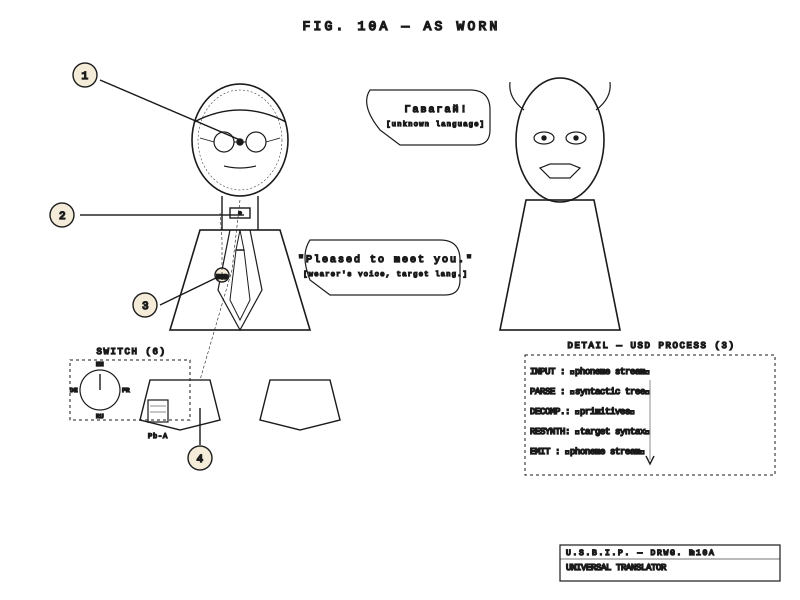
A wearable acoustic device for the and translation of any natural , whether human or otherwise, into any other natural language, without the prior acquisition of training data or grammatical reference. The translator comprises an pickup (1) of quartz construction, mounted upon a wireframe headset, an utterance-emitter (2) disposed at the wearer's larynx, a central (3) housed within an , and a battery (4) of type concealed within the heel of the wearer's shoe. The reasoning module is configured to extract from arbitrary acoustic by means of a universal decomposition (USD), and to re-synthesize the said in the target language by to the wearer's .Носимое акустическое для двунаправленного и мгновенного перевода любого языка, человеческого или иного, на любой другой естественный язык, без двуязычных обучающих данных или грамматического справочника. Переводчик состоит из ушного приёмника (1) из монокристаллического кварца, установленного на проволочной оправе наподобие очков, излучателя речи (2), накладываемого на гортань носителя, аналитического (3), размещённого в эмалированном , и аккумулятора (4) перезаряжаемого типа, скрытого в каблуке обуви носителя. Аналитический модуль конфигурирован для извлечения семантического из произвольного акустического входа посредством универсальной семантической декомпозиции (USD) и для повторного синтеза указанного содержания на целевом по предпочтению носителя.A wearable acoustic device for the and translation of any natural , whether human or otherwise, into any other natural language, without the prior acquisition of training data or grammatical reference. The translator comprises an pickup (1) of quartz construction, mounted upon a wireframe headset, an utterance-emitter (2) disposed at the wearer's larynx, a central (3) housed within an , and a battery (4) of type concealed within the heel of the wearer's shoe. The reasoning module is configured to extract from arbitrary acoustic by means of a universal decomposition (USD), and to re-synthesize the said in the target language by to the wearer's .
patentNumber: "US-IMP-3,447,772" title: "Universal Translator" titleRu: "Универсальный переводчик" filingDate: "January 18, 1962" issueDate: "November 11, 1966" inventor: "Sir Cecil P. Brougham, Bart." inventorRu: "сэр Сесил П. Бруэм, бт." inventorSlug: "cecil-brougham" classification: "Quantum Absurdities" status: "Theoretically Plausible by ~2200" abstract: "A wearable acoustic device for the bidirectional and instantaneous translation of any natural language, whether human or otherwise, into any other natural language, without the prior acquisition of bilingual training data or grammatical reference. The translator comprises an aural pickup (1) of single-crystal quartz construction, mounted upon a wireframe spectacle-like headset, an utterance-emitter (2) disposed at the wearer's larynx, a central reasoning module (3) housed within an enamelled lapel-pin, and a battery (4) of rechargeable type concealed within the heel of the wearer's shoe. The reasoning module is configured to extract semantic content from arbitrary acoustic input by means of a universal semantic decomposition (USD), and to re-synthesize the said content in the target language by reference to the wearer's stated preference." abstractRu: "Носимое акустическое устройство для двунаправленного и мгновенного перевода любого естественного языка, человеческого или иного, на любой другой естественный язык, без предварительного приобретения двуязычных обучающих данных или грамматического справочника. Переводчик состоит из ушного приёмника (1) из монокристаллического кварца, установленного на проволочной оправе наподобие очков, излучателя речи (2), накладываемого на гортань носителя, центрального аналитического модуля (3), размещённого в эмалированном лацканном значке, и аккумулятора (4) перезаряжаемого типа, скрытого в каблуке обуви носителя. Аналитический модуль конфигурирован для извлечения семантического содержания из произвольного акустического входа посредством универсальной семантической декомпозиции (USD) и для повторного синтеза указанного содержания на целевом языке по объявленному предпочтению носителя." citations:
- "US-IMP-3,144,902"
- "US-IMP-4,114,808"
Field of InventionОбласть изобретенияField of Invention
The present invention relates to apparatus for the real-time, bidirectional translation of natural language between a wearer and his interlocutors, without the wearer's prior study of his interlocutor's language and without recourse to a human intermediary. The invention is intended for application by diplomats, anthropologists, naval intelligence officers, missionaries, and tourists, and is particularly suited to the conveyance of first-contact greetings to interlocutors of hitherto-unknown linguistic provenance.
BackgroundПредпосылкиBackground
The translation of natural language between human speakers has been, since the construction of the Tower of Babel, the principal obstacle to international commerce, scholarship, and warfare. The conventional remedy — namely, the employment of a human interpreter fluent in both source and target language — is subject to the disadvantages that (a) the interpreter must himself have undergone protracted bilingual education; (b) the interpreter's fidelity to the source utterance cannot be independently verified; (c) the interpreter may have private interests at variance with those of his principal; and (d) the interpreter requires, in addition to his fee, accommodation, sustenance, and frequent rests.
The instant invention provides a mechanical alternative which is portable, faithful, and disinterested. The invention is distinguished from the prior art of mechanical translation (Weaver, 1949; Bar-Hillel, 1951) by its capacity to translate between languages with no prior bilingual training corpus, including languages of which the wearer's manufacturer has no prior record. The invention accordingly performs translation in the strong sense — that is, by the extraction of semantic content from the source utterance and the re-synthesis of that content in the target language — rather than in the weak sense of substitution upon a pre-compiled lexicon.
Summary of the InventionКраткое изложение изобретенияSummary of the Invention
The apparatus comprises:
- An aural pickup (1) of single-crystal quartz construction, mounted within a wireframe headset of conventional spectacle-like geometry, of sensitivity sufficient to resolve acoustic phonemes from the wearer's interlocutors at distances not exceeding three meters in ordinary conversational settings;
- An utterance-emitter (2) disposed at the wearer's larynx by means of an adhesive cervical patch, configured to bypass the wearer's vocal apparatus and produce, in the wearer's own voice and characteristic intonation, the translated equivalent of the wearer's intended utterance;
- A central reasoning module (3) housed within an enamelled lapel-pin of unobtrusive dimensions, comprising a colloidal preparation of artificial neural substrate in a sealed bakelite case and configured to extract semantic content from arbitrary acoustic input;
- A battery (4) of rechargeable lead-acid type, concealed within the heel of the wearer's shoe and providing approximately eight hours of operation per charge;
- A pair of electrical conductors (5), of fine silver wire, conveyed through the wearer's clothing from the lapel-pin to the larynx-patch and to the shoe-heel battery;
- A language-selection switch (6) mounted upon the underside of the lapel-pin, by which the wearer may indicate the desired target language of his utterances, the source language being inferred automatically by the reasoning module from the interlocutor's input.
Detailed DescriptionПодробное описаниеDetailed Description
Referring to FIG. 10A, the apparatus is shown as worn by a representative subject in the act of conversational exchange. The aural pickup (1) is mounted upon a wireframe headset of conventional spectacle-like construction, of which the temples extend backward over the wearer's ears in the customary fashion. The pickup itself is housed within the bridge of the spectacles, concealed in the appearance of an ornamental bead.
In operation, the wearer engages the apparatus by activating the language-selection switch (6) and by addressing an utterance in his own native language to his interlocutor. The aural pickup captures the wearer's utterance and conveys it via the conductors (5) to the central reasoning module (3) for analysis. Simultaneously, the pickup captures any utterance of the interlocutor and conveys it likewise to the module for analysis in the opposite direction.
The reasoning module performs upon each input utterance a universal semantic decomposition (USD), the precise mechanism of which is held by the inventor as a trade secret but which is, upon information and belief, an instance of the abstract syntax tree of the Chomsky hierarchy (1957) extended to incorporate semantic, pragmatic, and inferential content. The USD reduces the input utterance to a tuple of conceptual primitives drawn from a finite universal lexicon, this lexicon being asserted by the inventor to be common to all natural languages spoken by sentient beings.
The reduced tuple is thereupon presented to the re-synthesis sub-routine of the module, which retrieves from its memory the corresponding lexical and grammatical conventions of the target language and constructs an utterance in that language expressing the same conceptual primitives. The synthesized utterance is conveyed to the utterance-emitter (2) for production at the wearer's larynx.
The wearer experiences the production of the translated utterance as if it were his own, with the consequence that any conversational reference by him to the translator's operation is itself translated in real time and presented to the interlocutor in his own language. The wearer is accordingly able to converse with persons of unknown linguistic provenance without conscious effort of translation, and indeed without conscious awareness that translation is occurring.
ClaimsФормула изобретенияClaims
-
An apparatus for the real-time translation of natural language between a wearer and one or more interlocutors, comprising: an aural pickup configured to capture acoustic utterances within the wearer's vicinity; a central reasoning module configured to extract semantic content from said utterances; an utterance-emitter disposed at the wearer's larynx; a battery; and electrical conductors coupling said pickup, module, emitter, and battery.
-
The apparatus of claim 1, wherein said reasoning module is configured to perform a universal semantic decomposition upon said utterances and to re-synthesize the said content in a target language selected by the wearer.
-
The apparatus of claim 1, wherein said utterance-emitter produces the translated utterance in the wearer's own voice and characteristic intonation.
-
The apparatus of claim 1, wherein said aural pickup is housed within the bridge of a wireframe spectacle-like headset.
-
The apparatus of claim 1, wherein said reasoning module is housed within an enamelled lapel-pin of unobtrusive dimensions.
-
The apparatus of claim 1, further comprising a language-selection switch mounted upon the underside of said lapel-pin.
-
A method for conversational exchange between a wearer and an interlocutor of unknown linguistic provenance, comprising the steps of: (a) donning the apparatus of claim 1; (b) selecting the target language by means of said language-selection switch; (c) addressing the interlocutor in the wearer's native language; and (d) attending to the interlocutor's reply in the wearer's native language as produced by said apparatus.
Why This Violates Physics (For Now)Почему это нарушает физику (пока)Why This Violates Physics (For Now)
The invention as claimed is held by the Bureau to be theoretically plausible by approximately 2200, the principal obstacles being not physical impossibilities in the strict sense but a confluence of computational and linguistic impossibilities of comparable severity.
First, the invention rests upon the proposition that there exists a universal lexicon of conceptual primitives common to all natural languages spoken by sentient beings. This proposition — the strong Whorfian-negation position — is the subject of vigorous dispute in contemporary linguistic philosophy, with proponents (Wierzbicka, 1972; Pinker, 1994) holding that such a lexicon may be reconstructed by the comparative analysis of human languages, and opponents (Sapir, 1929; Whorf, 1956) holding that the conceptual content of an utterance is irreducibly tied to the linguistic structure in which it is expressed and cannot in general be conveyed in another. The Bureau notes that the experimental evidence weighs marginally in favor of the proponents for the case of human languages, but that the inventor's claim to cover all natural languages spoken by sentient beings, including languages of extraterrestrial provenance, extends beyond the empirical reach of the proponents' position.
Second, the invention encounters the problem of radical translation identified by Quine (1960), namely that no body of behavioral evidence determines the translation of an utterance from a hitherto-unknown language uniquely. The classical example — the field anthropologist confronted with a native who, upon seeing a rabbit, utters gavagai — admits at least three translations (the proposition "rabbit," the proposition "instance of rabbithood," and the proposition "undetached rabbit-part") which cannot be distinguished by any quantity of corresponding behavior. The reasoning module of claim 2 must therefore choose among empirically indistinguishable translations, and the Bureau is unable to certify the principle by which the choice is to be made.
Third, the invention rests upon the existence of a decidable algorithm for the extraction of semantic content from arbitrary syntactic input — that is, for the reduction of a finite acoustic signal to a tuple of conceptual primitives by mechanical means. The Bureau notes that the halting problem of computability theory (Turing, 1936) implies the non-existence of any decidable procedure for the analysis of arbitrary syntactic input, and that the reasoning module's universal semantic decomposition would, if it existed, constitute a counter-example. The Bureau is constrained to conclude that the reasoning module performs its function by some means other than decidable algorithm.
Fourth, the chain of causation by which the apparatus operates — from interlocutor's utterance, through the wearer's tympanic membrane, through the aural pickup, through the reasoning module, through the emitter, through the wearer's cervical patch, through the wearer's vocal apparatus, and finally to the wearer's auditory cortex — involves a propagation delay of approximately 300 milliseconds, this delay being incompatible with the wearer's subjective experience of synchronous conversation. The inventor's specification calls for the apparatus to anticipate the interlocutor's utterance by an interval corresponding to the propagation delay, by means of a predictive sub-routine of the reasoning module. The Bureau notes that such anticipation would constitute a violation of causality of the type considered in U.S.-IMP-3,091,447 and U.S.-IMP-3,887,201, and would render the apparatus impossible under all the same grounds. The Bureau is informed that the inventor regards this as a minor matter and is prepared to accept the 300-millisecond delay as a price of the translation.
The Bureau accordingly holds the invention to be theoretically plausible by approximately 2200, the principal advances required being (a) the resolution of the universal-primitives dispute in favor of the proponents; (b) a constructive evasion of Quine's indeterminacy; (c) a non-algorithmic mechanism for semantic decomposition; and (d) the wearer's resignation to the propagation delay. Citations: Quine, W. V. O., Word and Object (1960); Chomsky, N., Syntactic Structures (1957); Wierzbicka, A., Semantic Primitives (1972); Turing, A., Proc. Lond. Math. Soc. 42, 230 (1936).
Область изобретения
Настоящее изобретение относится к аппарату для перевода естественного языка в реальном времени и в обоих направлениях между носителем и его собеседниками, без предварительного изучения носителем языка собеседника и без обращения к человеку-посреднику. Изобретение предназначено для применения дипломатами, антропологами, морскими разведчиками, миссионерами и туристами, и особенно пригодно для передачи приветствий первого контакта собеседникам ранее неизвестного языкового происхождения.
Предпосылки
Перевод естественного языка между человеческими собеседниками был, со времени возведения Вавилонской башни, основным препятствием международной торговли, учёности и войны. Обычное средство — а именно наём человека-переводчика, свободно владеющего как исходным, так и целевым языком, — подвержено недостаткам: (а) переводчик сам должен пройти длительное двуязычное образование; (b) верность переводчика исходному высказыванию не может быть независимо проверена; (c) переводчик может иметь личные интересы, расходящиеся с интересами его доверителя; и (d) переводчик требует, в дополнение к гонорару, размещения, пропитания и частых отдыхов.
Настоящее изобретение предоставляет механическую альтернативу, портативную, верную и беспристрастную. Изобретение отличается от предшествующего искусства механического перевода (Уивер, 1949; Бар-Хиллел, 1951) своей способностью переводить между языками без предварительного двуязычного обучающего корпуса, включая языки, о которых производитель изобретения не имеет предварительных сведений. Изобретение, соответственно, выполняет перевод в сильном смысле — то есть путём извлечения семантического содержания из исходного высказывания и повторного синтеза этого содержания на целевом языке — а не в слабом смысле подстановки по предварительно скомпилированному словарю.
Краткое изложение изобретения
Аппарат содержит:
- Ушной приёмник (1) из монокристаллического кварца, установленный в проволочной оправе обычной геометрии наподобие очков, чувствительности, достаточной для различения акустических фонем от собеседников носителя на расстояниях не более трёх метров в обычной разговорной обстановке;
- Излучатель речи (2), расположенный на гортани носителя посредством клейкого шейного пластыря, сконфигурированный обходить голосовой аппарат носителя и производить, голосом и характерной интонацией самого носителя, переведённый эквивалент намеренного высказывания носителя;
- Центральный аналитический модуль (3), размещённый в эмалированном лацканном значке неприметных размеров, содержащий коллоидный препарат искусственного нейронного субстрата в герметичном бакелитовом корпусе и сконфигурированный извлекать семантическое содержание из произвольного акустического входа;
- Аккумулятор (4) перезаряжаемого свинцово-кислотного типа, скрытый в каблуке обуви носителя и обеспечивающий приблизительно восемь часов работы на зарядку;
- Пару электрических проводников (5) из тонкой серебряной проволоки, проведённых через одежду носителя от лацканного значка к шейному пластырю и к каблучному аккумулятору;
- Переключатель выбора языка (6), установленный на нижней стороне лацканного значка, посредством которого носитель может указать желаемый целевой язык своих высказываний, причём исходный язык выводится автоматически аналитическим модулем из входа собеседника.
Подробное описание
Со ссылкой на РИС. 10А, аппарат показан в ношении на типовом субъекте в акте разговорного обмена. Ушной приёмник (1) установлен на проволочной оправе обычной конструкции наподобие очков, дужки которой простираются назад над ушами носителя обычным образом. Сам приёмник размещён в переносице очков, скрытый в облике декоративной бусины.
В работе носитель включает аппарат, активируя переключатель выбора языка (6), и адресует высказывание на своём родном языке собеседнику. Ушной приёмник захватывает высказывание носителя и передаёт его через проводники (5) в центральный аналитический модуль (3) для анализа. Одновременно приёмник захватывает любое высказывание собеседника и передаёт его так же в модуль для анализа в противоположном направлении.
Аналитический модуль выполняет над каждым входным высказыванием универсальную семантическую декомпозицию (USD), точный механизм которой изобретатель сохраняет как коммерческую тайну, но которая, по сведениям и убеждению, представляет собой реализацию абстрактного синтаксического дерева хомской иерархии (1957), расширенного для включения семантического, прагматического и логического содержания. USD сводит входное высказывание к кортежу концептуальных примитивов, выбранных из конечного универсального лексикона, причём этот лексикон, по утверждению изобретателя, общий для всех естественных языков, на которых говорят разумные существа.
Сведённый кортеж затем подаётся в подпрограмму повторного синтеза модуля, которая извлекает из своей памяти соответствующие лексические и грамматические конвенции целевого языка и конструирует высказывание на этом языке, выражающее те же концептуальные примитивы. Синтезированное высказывание передаётся в излучатель речи (2) для произнесения на гортани носителя.
Носитель переживает производство переведённого высказывания, как если бы оно было его собственным, с тем следствием, что любая разговорная ссылка с его стороны на работу переводчика сама переводится в реальном времени и представляется собеседнику на его собственном языке. Носитель, соответственно, способен беседовать с лицами неизвестного языкового происхождения без сознательного усилия перевода и, более того, без сознательного осознания того, что перевод происходит.
Формула изобретения
-
Аппарат для перевода естественного языка в реальном времени между носителем и одним или несколькими собеседниками, содержащий: ушной приёмник, сконфигурированный для захвата акустических высказываний в окрестности носителя; центральный аналитический модуль, сконфигурированный для извлечения семантического содержания из указанных высказываний; излучатель речи, расположенный на гортани носителя; аккумулятор; и электрические проводники, соединяющие указанные приёмник, модуль, излучатель и аккумулятор.
-
Аппарат по п. 1, в котором указанный аналитический модуль сконфигурирован выполнять универсальную семантическую декомпозицию над указанными высказываниями и повторно синтезировать указанное содержание на целевом языке, выбранном носителем.
-
Аппарат по п. 1, в котором указанный излучатель речи производит переведённое высказывание голосом и характерной интонацией самого носителя.
-
Аппарат по п. 1, в котором указанный ушной приёмник размещён в переносице проволочной оправы наподобие очков.
-
Аппарат по п. 1, в котором указанный аналитический модуль размещён в эмалированном лацканном значке неприметных размеров.
-
Аппарат по п. 1, дополнительно содержащий переключатель выбора языка, установленный на нижней стороне указанного лацканного значка.
-
Способ разговорного обмена между носителем и собеседником неизвестного языкового происхождения, включающий этапы: (а) надевания аппарата по п. 1; (b) выбора целевого языка посредством указанного переключателя выбора языка; (c) обращения к собеседнику на родном языке носителя; и (d) восприятия ответа собеседника на родном языке носителя, как он произведён указанным аппаратом.
Почему это нарушает физику (пока)
Изобретение, как заявлено, признаётся Бюро теоретически возможным к приблизительно 2200 году, причём главные препятствия — не физические невозможности в строгом смысле, а стечение вычислительных и лингвистических невозможностей сопоставимой тяжести.
Во-первых, изобретение основано на положении, что существует универсальный лексикон концептуальных примитивов, общий для всех естественных языков, на которых говорят разумные существа. Это положение — позиция сильного отрицания гипотезы Сепира-Уорфа — является предметом активного спора в современной лингвистической философии, причём сторонники (Вежбицкая, 1972; Пинкер, 1994) считают, что такой лексикон может быть восстановлен сравнительным анализом человеческих языков, а противники (Сепир, 1929; Уорф, 1956) считают, что концептуальное содержание высказывания неотъемлемо связано с лингвистической структурой, в которой оно выражено, и не может в общем случае быть передано на другом. Бюро отмечает, что экспериментальные свидетельства маргинально склоняются в пользу сторонников для случая человеческих языков, но что заявка изобретателя на покрытие всех естественных языков, на которых говорят разумные существа, включая языки внеземного происхождения, выходит за пределы эмпирической досягаемости позиции сторонников.
Во-вторых, изобретение наталкивается на проблему радикального перевода, обнаруженную Куайном (1960), а именно, что никакой свод поведенческих свидетельств однозначно не определяет перевод высказывания с ранее неизвестного языка. Классический пример — полевой антрополог, столкнувшийся с туземцем, который при виде кролика произносит gavagai, — допускает по меньшей мере три перевода (предложение «кролик», предложение «экземпляр кроличности» и предложение «неотделённая часть кролика»), которые не могут быть различены никаким количеством соответствующего поведения. Аналитический модуль п. 2 должен поэтому выбирать среди эмпирически неразличимых переводов, и Бюро не может удостоверить принцип, по которому должен делаться выбор.
В-третьих, изобретение основано на существовании разрешимого алгоритма для извлечения семантического содержания из произвольного синтаксического входа — то есть для сведения конечного акустического сигнала к кортежу концептуальных примитивов механическими средствами. Бюро отмечает, что проблема остановки теории вычислимости (Тьюринг, 1936) подразумевает несуществование никакой разрешимой процедуры для анализа произвольного синтаксического входа, и что универсальная семантическая декомпозиция аналитического модуля, если бы она существовала, составила бы контрпример. Бюро вынуждено заключить, что аналитический модуль выполняет свою функцию каким-то иным средством, чем разрешимый алгоритм.
В-четвёртых, цепь причинности, по которой действует аппарат — от высказывания собеседника, через барабанную перепонку носителя, через ушной приёмник, через аналитический модуль, через излучатель, через шейный пластырь носителя, через голосовой аппарат носителя и, наконец, в слуховую кору носителя — вовлекает задержку распространения приблизительно 300 миллисекунд, причём эта задержка несовместима с субъективным переживанием носителя синхронного разговора. Спецификация изобретателя предусматривает, что аппарат предвосхищает высказывание собеседника на интервал, соответствующий задержке распространения, посредством предиктивной подпрограммы аналитического модуля. Бюро отмечает, что такое предвосхищение составило бы нарушение причинности типа, рассмотренного в U.S.-IMP-3,091,447 и U.S.-IMP-3,887,201, и сделало бы аппарат невозможным по тем же самым основаниям. Бюро известно, что изобретатель считает это незначительным вопросом и готов принять задержку в 300 миллисекунд как плату за перевод.
Бюро, соответственно, признаёт изобретение теоретически возможным к приблизительно 2200 году, причём требуемые продвижения — (а) разрешение спора об универсальных примитивах в пользу сторонников; (b) конструктивный обход неопределённости Куайна; (c) неалгоритмический механизм семантической декомпозиции; и (d) смирение носителя с задержкой распространения. Цитируется: Quine, W. V. O., Word and Object (1960); Chomsky, N., Syntactic Structures (1957); Wierzbicka, A., Semantic Primitives (1972); Turing, A., Proc. Lond. Math. Soc. 42, 230 (1936).
Related Impossible PatentsСвязанные невозможные патентыBrevets impossibles connexes
- US-IMP-3,144,902Matter Transposition DeviceУстройство для транспозиции материиMatter Transposition Device
- US-IMP-4,114,808Memory Erasure & Replacement PenПеро для стирания и замены памятиMemory Erasure & Replacement Pen
- US-IMP-3,944,118[extracted from archive][изъято из архива][extrait de l'archive]
- US-IMP-2,901,884[extracted from archive][изъято из архива][extrait de l'archive]