United States Bureau of Impossible PatentsБюро невозможных патентов СШАBureau américain des brevets impossibles
Maxwell's Demon Refrigeration UnitХолодильная установка с демоном МаксвеллаMaxwell's Demon Refrigeration Unit
Patent № US-IMP-2,991,???Патент № US-IMP-2,991,???Patent № US-IMP-2,991,???
- Caveat
- ORCON · NOFORN · REL TO BUREAU PERSONNEL · NO COPY
- Compartment
- KEYHOLE/TALON
- Distribution
- ██ copies authorized · all numbered · all logged
- Declassify on
- ██████████ + 50 Y from filing date
- Access log entry
- Folio #06155 · accessed by ████████ · 12-██-████
- Warning
- This document contains national-defense information. Mishandling subject to criminal sanctions under 18 U.S.C. §§ 793, 794.
- Гриф
- С согласия источника · Без передачи иностранцам · Не копировать
- Отделение
- ЗАМОЧНАЯ/КОГОТЬ
- Распространение
- ██ разрешённых копий · все номерные · все журналируются
- Срок рассекречивания
- ██████████ + 50 лет от даты подачи
- Запись в журнале
- Том №06155 · выдан ████████ · 12-██-████
- Внимание
- Документ содержит сведения, составляющие государственную тайну. Нарушение режима преследуется по закону.
- Caveat
- ORCON · NOFORN · REL TO BUREAU PERSONNEL · NO COPY
- Compartment
- KEYHOLE/TALON
- Distribution
- ██ copies authorized · all numbered · all logged
- Declassify on
- ██████████ + 50 Y from filing date
- Access log entry
- Folio #06155 · accessed by ████████ · 12-██-████
- Warning
- This document contains national-defense information. Mishandling subject to criminal sanctions under 18 U.S.C. §§ 793, 794.
AbstractРефератRésuméPartially RedactedЧастично затёртоPartiellement caviardé
A refrigeration apparatus operating without of external , comprising a sealed gas-tight enclosure (1) partitioned into a colder chamber (2) and a warmer chamber (3) by an internal wall (4), wall being pierced by a single small aperture (5) of comparable to the mean free path of the working gas, said aperture being fitted with a friction-less (6) operated by an agent (7) of dimensions which observes the velocity of each gas approaching the aperture and opens the shutter to the passage of fast molecules from the colder chamber to the warmer, and slow molecules from the warmer chamber to the colder, while preventing the passage of all other molecules. The aggregate effect of said selective operation is to establish a temperature difference between the two chambers without the performance of work by any external agent.Холодильный аппарат, работающий без потребления энергии, состоящий из герметичного газонепроницаемого корпуса (1), разделённого внутренней (4) на холодную камеру (2) и тёплую камеру (3); указанная прорезана единственным малым отверстием (5) размером порядка длины свободного пробега рабочего газа. Отверстие снабжено заслонкой (6), управляемой разумным (7) микроскопических размеров, наблюдает скорость каждой молекулы газа, приближающейся к , и открывает заслонку для пропуска быстрых молекул из камеры в и медленных молекул из тёплой камеры в холодную, препятствуя проходу всех прочих. Совокупное такой избирательной устанавливает разность температур между двумя камерами без совершения работы каким-либо агентом.A refrigeration apparatus operating without of external , comprising a sealed gas-tight enclosure (1) partitioned into a colder chamber (2) and a warmer chamber (3) by an internal wall (4), wall being pierced by a single small aperture (5) of comparable to the mean free path of the working gas, said aperture being fitted with a friction-less (6) operated by an agent (7) of dimensions which observes the velocity of each gas approaching the aperture and opens the shutter to the passage of fast molecules from the colder chamber to the warmer, and slow molecules from the warmer chamber to the colder, while preventing the passage of all other molecules. The aggregate effect of said selective operation is to establish a temperature difference between the two chambers without the performance of work by any external agent.
patentNumber: "US-IMP-2,991,103" title: "Maxwell's Demon Refrigeration Unit" titleRu: "Холодильная установка с демоном Максвелла" filingDate: "June 19, 1923" issueDate: "December 7, 1927" inventor: "Prof. Wilhelm K. Strauss" inventorRu: "проф. Вильгельм К. Штраус" inventorSlug: "wilhelm-strauss" classification: "Thermodynamic Heresies" status: "Provisionally Impossible" abstract: "A refrigeration apparatus operating without consumption of external power, comprising a sealed gas-tight enclosure (1) partitioned into a colder chamber (2) and a warmer chamber (3) by an internal wall (4), said wall being pierced by a single small aperture (5) of dimension comparable to the mean free path of the working gas, said aperture being fitted with a friction-less shutter (6) operated by an intelligent agent (7) of microscopic dimensions which observes the velocity of each gas molecule approaching the aperture and opens the shutter to permit the passage of fast molecules from the colder chamber to the warmer, and slow molecules from the warmer chamber to the colder, while preventing the passage of all other molecules. The aggregate effect of said selective operation is to establish a temperature difference between the two chambers without the performance of work by any external agent." abstractRu: "Холодильный аппарат, работающий без потребления внешней энергии, состоящий из герметичного газонепроницаемого корпуса (1), разделённого внутренней стенкой (4) на холодную камеру (2) и тёплую камеру (3); указанная стенка прорезана единственным малым отверстием (5) размером порядка длины свободного пробега рабочего газа. Отверстие снабжено бесфрикционной заслонкой (6), управляемой разумным агентом (7) микроскопических размеров, который наблюдает скорость каждой молекулы газа, приближающейся к отверстию, и открывает заслонку для пропуска быстрых молекул из холодной камеры в тёплую и медленных молекул из тёплой камеры в холодную, препятствуя проходу всех прочих. Совокупное действие такой избирательной работы устанавливает разность температур между двумя камерами без совершения работы каким-либо внешним агентом." citations:
- "US-IMP-2,847,221"
Field of InventionОбласть изобретенияField of Invention
The present invention relates to apparatus for the production of refrigeration — that is, for the maintenance of one region of a system at a temperature lower than that of its surroundings — and more particularly to the production of such refrigeration without the consumption of fuel, electrical power, or other external energetic input. The invention is intended for application in the preservation of foodstuffs, the cooling of habitations during the summer months, and the cryogenic liquefaction of gases for industrial and laboratory purposes.
BackgroundПредпосылкиBackground
Refrigeration in the modern sense is conventionally accomplished by means of a vapor-compression cycle, wherein a working fluid is alternately compressed and expanded with the aid of a mechanical pump, the latent heat of vaporization being absorbed from the refrigerated region during expansion and rejected to the surroundings during compression. The cycle is convenient and reliable but presents the disadvantages of (a) requiring a continuous input of mechanical power to the pump, with attendant fuel costs; (b) emitting an audible hum throughout its operation; and (c) introducing into the modern household an apparatus of indifferent reliability requiring the seasonal attentions of a costly repairman.
The instant invention obviates each of these disadvantages by dispensing with the mechanical pump altogether and substituting in its place a microscopic agent of selective perception, of the kind first contemplated by Maxwell (1867) in his celebrated Theory of Heat. The agent — which the inventor here designates as a "demon," following the convention introduced by Lord Kelvin (1874) — is of dimensions sufficiently small that it may observe the individual molecules of the working gas; sufficiently fast that it may operate the shutter (6) within the duration of a single molecular transit; and of sufficient intelligence that it may distinguish a fast molecule from a slow one and exercise its judgment accordingly.
Summary of the InventionКраткое изложение изобретенияSummary of the Invention
The apparatus comprises:
- A sealed gas-tight enclosure (1) of brass or stainless steel construction, of nominal interior volume one cubic meter, charged to one atmosphere absolute with a working gas comprising nominally dry air or, in alternative embodiments, helium or argon;
- An internal wall (4) of asbestos-board construction, partitioning the enclosure into a colder chamber (2) of one-half cubic meter and a warmer chamber (3) of one-half cubic meter, the chambers being initially identical in temperature and composition;
- A single aperture (5) pierced through said internal wall, of nominal diameter one micrometer, comparable to the mean free path of the working gas at the design conditions;
- A friction-less shutter (6) covering said aperture, fabricated of a single sheet of aluminium foil and pivoted upon a sapphire bearing of negligible friction;
- An intelligent agent (7) of microscopic dimensions, resident in the immediate vicinity of the aperture, configured to observe the velocity of each gas molecule approaching the aperture and to operate the shutter accordingly;
- A pair of mercury thermometers (8), one in each chamber, by which the developing temperature difference may be observed by an external operator;
- A heat exchanger (9) coupled to the colder chamber, by which the refrigeration produced therein may be conveyed to such external use as may be desired (e.g., an icebox attached to the side of the enclosure);
- A food chamber (10), being a cavity within the cold side, of approximate volume sufficient for one gallon of milk and a quantity of cheeses.
Detailed DescriptionПодробное описаниеDetailed Description
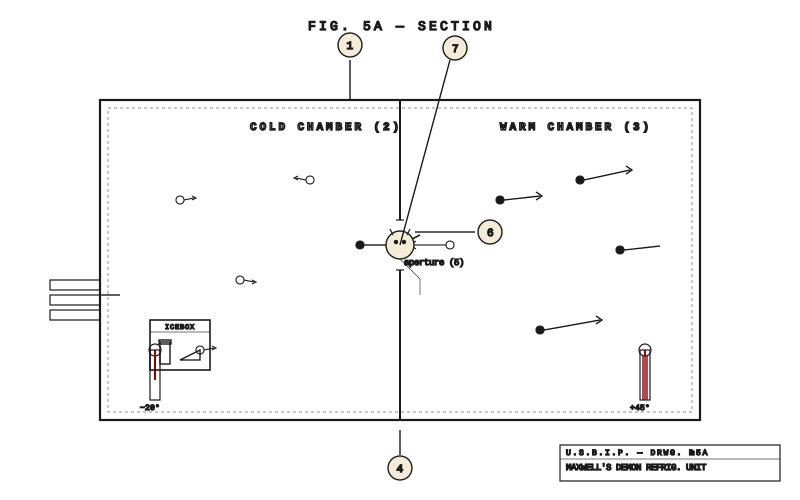
Referring to FIG. 5A, the apparatus is shown in cross-section. The outer enclosure (1) is of welded brass construction, of internal dimension one meter cubed, fitted with a gas-tight access port for the introduction of the working gas and for the periodic relief of the agent.
The internal wall (4) is bonded gas-tight to the enclosure's interior and is centrally pierced by the aperture (5). The aperture is sufficiently small that, at the working pressure of one atmosphere, the rate of molecular transits through the aperture (in either direction, in the absence of intervention by the agent) is approximately 10¹⁰ per second, this rate being well within the operating bandwidth of the agent (see below).
The shutter (6) is mounted upon a sapphire bearing of friction coefficient not exceeding 10⁻⁶, and is operated by a fine linkage of human-hair-and-shellac construction extending from the pivot to the station of the agent (7). The shutter is configured to be normally closed; opening is effected only at the direction of the agent and only for the duration of one molecular transit.
The agent (7) is of dimensions approximately one micrometer in each linear extent and is of a constitution which the inventor has reserved as a trade secret, but which, upon information and belief, comprises a colony of Pseudomonas of unusually well-developed faculties, cultured in the inventor's laboratory through a process of selective breeding over a period of approximately twenty-five years. The agent is fed a diet of nutrient agar twice daily by means of a feeding tube extending through the enclosure's wall.
In normal operation, the agent observes the velocity of each gas molecule approaching the aperture from either side. Upon detection of (a) a molecule of speed greater than the root-mean-square thermal speed approaching from the cold side, the agent opens the shutter momentarily and permits the molecule to pass into the warm side; or (b) a molecule of speed less than the root-mean-square thermal speed approaching from the warm side, the agent likewise opens the shutter and permits the molecule to pass into the cold side. In all other cases, the agent withholds the shutter and the molecule is reflected without passage.
By this protocol of operation, the mean speed of molecules within the warm chamber is gradually increased and the mean speed within the cold chamber is gradually decreased, with the consequence that the temperature of the warm chamber rises and that of the cold chamber falls. The apparatus accordingly produces a temperature difference between the two chambers without the consumption of external power, and the cold chamber may be used to refrigerate such foodstuffs as may be deposited therein.
ClaimsФормула изобретенияClaims
-
A refrigeration apparatus comprising: a sealed enclosure; an internal partition dividing said enclosure into a first chamber and a second chamber; an aperture pierced through said partition; a shutter operatively coupled to said aperture; and an intelligent agent disposed in the vicinity of said aperture and configured to operate said shutter selectively in response to the velocity of gas molecules approaching said aperture.
-
The apparatus of claim 1, wherein said aperture is of nominal diameter not exceeding one micrometer.
-
The apparatus of claim 1, wherein said agent is configured to permit the passage of molecules of speed greater than the root-mean-square thermal speed from said first to said second chamber, and the passage of molecules of speed less than said speed from said second to said first chamber, and to prevent all other passages.
-
The apparatus of claim 1, wherein said agent comprises a culture of Pseudomonas of selectively-bred constitution.
-
The apparatus of claim 1, further comprising a pair of thermometers, one in each chamber, for the observation of the developing temperature difference.
-
The apparatus of claim 1, further comprising a heat exchanger coupled to one of said chambers for the application of the refrigeration produced therein.
-
A method for the production of refrigeration without consumption of external power, comprising the steps of: (a) charging the apparatus of claim 1 with a working gas; (b) instructing said agent in the protocol of operation; (c) supplying said agent with nutrient agar twice daily; and (d) waiting.
Why This Violates Physics (For Now)Почему это нарушает физику (пока)Why This Violates Physics (For Now)
The invention as claimed is, beyond reasonable dispute, provisionally impossible. It is the canonical example, in the philosophy of physics, of an apparatus which appears to violate the Second Law of Thermodynamics, and the analysis of its impossibility constitutes a significant portion of the foundational literature of statistical mechanics.
First, the apparatus as described produces a decrease in the entropy of an isolated system at no thermodynamic cost, the agent performing its selective operations without (according to the application) consuming any energy or producing any heat. The Second Law in the Clausius formulation holds that heat cannot of itself flow from a colder to a hotter body; the apparatus claims to perform precisely this operation through the agency of the demon. The Second Law in the Kelvin–Planck formulation holds that no cyclic process can convert heat entirely into work; the apparatus, by establishing a temperature difference from an initially uniform reservoir, creates precisely the conditions under which such conversion becomes possible. The apparatus therefore appears to permit the construction of a perpetual motion machine of the second kind, after the manner of U.S.-IMP-2,847,221.
Second, the resolution of this paradox has been the subject of investigation for nearly a century. The earliest serious analysis, by Szilard (1929), demonstrated that the measurement performed by the demon — the determination of each molecule's velocity prior to the operation of the shutter — is itself a thermodynamic process which generates entropy. Szilard estimated this entropy at approximately k ln 2 per measurement, where k is the Boltzmann constant; subsequent refinements by Brillouin (1951), Landauer (1961), and Bennett (1982) established that the irreversible erasure of the agent's memory (which must occur if the agent is not to grow without bound) is itself a process of entropy production at a rate not less than k ln 2 per erasure. The aggregate entropy production by measurement and erasure is precisely equal to, or exceeds, the entropy decrease produced by the selective shutter operation, and the Second Law is preserved.
Third, the apparatus is therefore not a violation of the Second Law if all entropy-producing operations are properly accounted; it is rather a mis-stated or incomplete description, the agent's measurement and memory-management costs having been omitted from the energetic accounting of the application. The Bureau notes that the inventor, upon being apprised of these considerations by counsel for the Examiner during the 1925 prosecution, declined to amend the application and instead introduced into the record his nutrient-agar feeding schedule (twice daily) as a candidate energetic input. The Bureau has examined this candidate and finds the total caloric content of the agar to be approximately 3.5 kilocalories per day, this figure being insufficient by approximately fourteen orders of magnitude to support the claimed refrigeration capacity.
Fourth, the apparatus is in any event inoperable for the further reason that an agent of microscopic dimensions, observing the velocity of gas molecules, cannot make such observation without scattering photons or other carriers from the molecule under observation, and the recoil of the molecule under such scattering perturbs its velocity by an amount of order unity, defeating the measurement. The Bureau notes that this difficulty has not been overcome by the inventor's Pseudomonas culture and is unlikely to be overcome by any candidate organism. Citations: Maxwell, J. C., Theory of Heat (1871); Szilard, L., Z. Phys. 53, 840 (1929); Landauer, R., IBM J. Res. Dev. 5, 183 (1961); Bennett, C. H., Int. J. Theor. Phys. 21, 905 (1982).
Область изобретения
Настоящее изобретение относится к аппарату для производства охлаждения — то есть для поддержания одной области системы при температуре ниже температуры её окружения, — и в частности — к производству такого охлаждения без потребления топлива, электрической энергии или иного внешнего энергетического входа. Изобретение предназначено для применения в сохранении продуктов питания, охлаждении жилых помещений в летние месяцы и криогенном сжижении газов для промышленных и лабораторных целей.
Предпосылки
Охлаждение в современном смысле обычно осуществляется посредством парокомпрессионного цикла, в котором рабочая жидкость попеременно сжимается и расширяется с помощью механического насоса, причём скрытая теплота парообразования поглощается из охлаждаемой области во время расширения и отводится в окружающую среду во время сжатия. Цикл удобен и надёжен, но имеет недостатки: (а) требует непрерывного поступления механической мощности к насосу с соответствующими топливными издержками; (b) издаёт слышимое гудение в течение всей работы; и (c) вводит в современное домашнее хозяйство устройство умеренной надёжности, требующее сезонного внимания дорогостоящего ремонтника.
Настоящее изобретение устраняет каждый из этих недостатков, отказываясь от механического насоса и заменяя его микроскопическим агентом избирательного восприятия, рода, впервые рассмотренного Максвеллом (1867) в его знаменитой Теории теплоты. Агент — которого изобретатель здесь обозначает как «демона», следуя соглашению, введённому лордом Кельвином (1874), — имеет достаточно малые размеры, чтобы наблюдать отдельные молекулы рабочего газа; достаточно быстр, чтобы оперировать заслонкой (6) в течение единственного молекулярного транзита; и достаточно разумен, чтобы отличать быструю молекулу от медленной и осуществлять своё суждение соответственно.
Краткое изложение изобретения
Аппарат содержит:
- Герметичный газонепроницаемый корпус (1) латунной или нержавстальной конструкции номинального внутреннего объёма один кубический метр, заряженный до одной атмосферы абсолютного давления рабочим газом, представляющим собой номинально сухой воздух или, в альтернативных вариантах, гелий или аргон;
- Внутреннюю стенку (4) асбестокартонной конструкции, делящую корпус на холодную камеру (2) объёмом полкубометра и тёплую камеру (3) объёмом полкубометра, причём камеры изначально идентичны по температуре и составу;
- Единственное отверстие (5), просверленное через указанную внутреннюю стенку, номинального диаметра один микрометр, сравнимого с длиной свободного пробега рабочего газа при расчётных условиях;
- Бесфрикционную заслонку (6), закрывающую указанное отверстие, изготовленную из единого листа алюминиевой фольги и подвешенную на сапфировом подшипнике пренебрежимо малого трения;
- Разумного агента (7) микроскопических размеров, постоянно находящегося в непосредственной окрестности отверстия, сконфигурированного наблюдать скорость каждой молекулы газа, приближающейся к отверстию, и оперировать заслонкой соответственно;
- Пару ртутных термометров (8), по одному в каждой камере, по которым развивающаяся разность температур может наблюдаться внешним оператором;
- Теплообменник (9), сопряжённый с холодной камерой, посредством которого произведённое в ней охлаждение может быть передано к любому желаемому внешнему применению (например, ледник, прикреплённый к боковой стенке корпуса);
- Пищевой отсек (10), полость на холодной стороне приблизительного объёма, достаточного для одного галлона молока и некоторого количества сыров.
Подробное описание
Со ссылкой на РИС. 5А, аппарат показан в поперечном разрезе. Внешний корпус (1) сварной латунной конструкции, внутренних размеров метр-куб, оснащён газонепроницаемым люком доступа для введения рабочего газа и для периодической смены агента.
Внутренняя стенка (4) скреплена газонепроницаемо с внутренней поверхностью корпуса и центрально пронизана отверстием (5). Отверстие достаточно мало, чтобы при рабочем давлении в одну атмосферу скорость молекулярных переходов через отверстие (в любом направлении, в отсутствие вмешательства агента) составляла приблизительно 10¹⁰ в секунду, эта скорость находится в пределах рабочей полосы пропускания агента (см. ниже).
Заслонка (6) подвешена на сапфировом подшипнике с коэффициентом трения не более 10⁻⁶ и приводится в действие тонкой передачей из конского волоса и шеллака, протянутой от шарнира к станции агента (7). Заслонка сконфигурирована быть нормально закрытой; открытие производится только по указанию агента и только на время одного молекулярного транзита.
Агент (7) имеет размеры приблизительно один микрометр по каждому линейному измерению и состав, который изобретатель сохранил как коммерческую тайну, но который, по сведениям и убеждению, представляет собой колонию Pseudomonas необычайно развитых способностей, выведенную в лаборатории изобретателя путём селективного разведения в течение приблизительно двадцати пяти лет. Агент кормится диетой из питательного агара дважды в день через подающую трубку, протянутую через стенку корпуса.
В нормальной работе агент наблюдает скорость каждой молекулы газа, приближающейся к отверстию с любой стороны. При обнаружении (а) молекулы со скоростью больше среднеквадратичной тепловой скорости, приближающейся с холодной стороны, агент мгновенно открывает заслонку и пропускает молекулу на тёплую сторону; либо (b) молекулы со скоростью меньше среднеквадратичной тепловой скорости, приближающейся с тёплой стороны, агент так же открывает заслонку и пропускает молекулу на холодную сторону. Во всех остальных случаях агент удерживает заслонку, и молекула отражается без прохода.
По этому протоколу работы средняя скорость молекул в тёплой камере постепенно увеличивается, а средняя скорость в холодной камере постепенно уменьшается, с тем следствием, что температура тёплой камеры растёт, а температура холодной — падает. Аппарат, соответственно, производит разность температур между двумя камерами без потребления внешней энергии, и холодная камера может использоваться для охлаждения тех продуктов, какие могут быть в неё помещены.
Формула изобретения
-
Холодильный аппарат, содержащий: герметичный корпус; внутреннюю перегородку, делящую указанный корпус на первую камеру и вторую камеру; отверстие, пронизывающее указанную перегородку; заслонку, функционально связанную с указанным отверстием; и разумного агента, расположенного в окрестности указанного отверстия и сконфигурированного оперировать указанной заслонкой избирательно в ответ на скорость молекул газа, приближающихся к указанному отверстию.
-
Аппарат по п. 1, в котором указанное отверстие имеет номинальный диаметр не более одного микрометра.
-
Аппарат по п. 1, в котором указанный агент сконфигурирован пропускать молекулы со скоростью больше среднеквадратичной тепловой скорости из указанной первой во вторую камеру и молекулы со скоростью меньше указанной скорости из указанной второй в первую камеру, и предотвращать все прочие проходы.
-
Аппарат по п. 1, в котором указанный агент представляет собой культуру Pseudomonas селективно-выведенного состава.
-
Аппарат по п. 1, дополнительно содержащий пару термометров, по одному в каждой камере, для наблюдения развивающейся разности температур.
-
Аппарат по п. 1, дополнительно содержащий теплообменник, сопряжённый с одной из указанных камер, для применения произведённого в ней охлаждения.
-
Способ производства охлаждения без потребления внешней энергии, включающий этапы: (а) заряжения аппарата по п. 1 рабочим газом; (b) инструктирования указанного агента в протоколе работы; (c) снабжения указанного агента питательным агаром дважды в день; и (d) ожидания.
Почему это нарушает физику (пока)
Изобретение, как заявлено, вне всяких разумных сомнений временно невозможно. Это канонический пример в философии физики аппарата, который, по-видимому, нарушает второе начало термодинамики, и анализ его невозможности составляет значительную часть фундаментальной литературы статистической механики.
Во-первых, описанный аппарат производит уменьшение энтропии изолированной системы без термодинамической цены; агент совершает свои избирательные операции, не потребляя (по словам заявки) никакой энергии и не производя никакого тепла. Второе начало в формулировке Клаузиуса утверждает, что тепло не может само по себе течь от более холодного тела к более горячему; аппарат заявляет о выполнении именно этой операции через посредство демона. Второе начало в формулировке Кельвина-Планка утверждает, что никакой циклический процесс не может полностью преобразовать тепло в работу; аппарат, устанавливая разность температур из изначально однородного резервуара, создаёт именно те условия, при которых такое преобразование становится возможным. Аппарат, таким образом, по-видимому, позволяет построить двигатель вечного движения второго рода, по образцу U.S.-IMP-2,847,221.
Во-вторых, разрешение этого парадокса было предметом исследования почти столетие. Самый ранний серьёзный анализ Силарда (1929) показал, что измерение, выполняемое демоном, — определение скорости каждой молекулы перед операцией заслонкой — само по себе является термодинамическим процессом, генерирующим энтропию. Силард оценил эту энтропию приблизительно в k ln 2 на измерение, где k — постоянная Больцмана; последующие уточнения Бриллюэна (1951), Ландауэра (1961) и Беннета (1982) установили, что необратимое стирание памяти агента (которое должно происходить, если агент не должен расти без границы) само по себе является процессом производства энтропии со скоростью не менее k ln 2 на стирание. Совокупное производство энтропии измерением и стиранием в точности равно или превышает уменьшение энтропии, произведённое избирательной операцией заслонкой, и второе начало сохраняется.
В-третьих, аппарат, таким образом, не является нарушением второго начала, если все энтропийно-производящие операции правильно учтены; он скорее неверно сформулированное или неполное описание, где затраты агента на измерение и управление памятью опущены из энергетического учёта заявки. Бюро отмечает, что изобретатель, будучи проинформирован об этих соображениях поверенным Эксперта во время рассмотрения 1925 года, отказался изменять заявку и вместо этого ввёл в протокол свой режим кормления питательным агаром (дважды в день) в качестве кандидата на энергетический вход. Бюро изучило этого кандидата и нашло общий калорийный состав агара приблизительно равным 3,5 килокалориям в день, что недостаточно приблизительно на четырнадцать порядков для поддержания заявленной холодильной мощности.
В-четвёртых, аппарат в любом случае неработоспособен по той дополнительной причине, что агент микроскопических размеров, наблюдающий скорость молекул газа, не может вести такое наблюдение без рассеяния фотонов или иных носителей от наблюдаемой молекулы, и отдача молекулы при таком рассеянии возмущает её скорость на величину порядка единицы, лишая измерение смысла. Бюро отмечает, что эта трудность не была преодолена культурой Pseudomonas изобретателя и вряд ли будет преодолена каким-либо кандидатным организмом. Цитируется: Maxwell, J. C., Theory of Heat (1871); Szilard, L., Z. Phys. 53, 840 (1929); Landauer, R., IBM J. Res. Dev. 5, 183 (1961); Bennett, C. H., Int. J. Theor. Phys. 21, 905 (1982).
Related Impossible PatentsСвязанные невозможные патентыBrevets impossibles connexes
- US-IMP-2,847,221Perpetual Motion Engine, Type CДвигатель вечного движения, тип CPerpetual Motion Engine, Type C
- US-IMP-3,944,118[extracted from archive][изъято из архива][extrait de l'archive]
- US-IMP-2,901,884[extracted from archive][изъято из архива][extrait de l'archive]